New Hampshire Uncharted Season 2, Episode 3: Who Pays for Public Education in New Hampshire?
Connecting New Hampshire
By: NHFPI Staff
Publication Date: March 23, 2026
Public education is one of the largest investments New Hampshire makes, and one of the most debated. The state relies more heavily on local property taxes to fund schools than most other states, creating major differences in tax rates and school funding across communities. For decades, that has raised a complex question: how can New Hampshire fund public education more fairly?
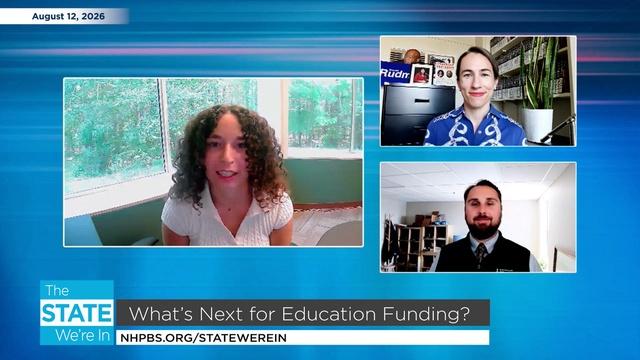
In Episode 3 of Season Two of New Hampshire Uncharted, host Gene Martin is joined by New Hampshire State Representative Walter Spilsbury, Vice Chair of the House Education Funding Committee, to discuss House Bill 1800, a proposal that could significantly change how education funding works in the Granite State.
The conversation explores how New Hampshire’s current school funding system works, why it creates such stark differences between communities, and what HB 1800 was designed to do. It also looks at the practical and political challenges of changing a system that has been debated for generations.
Why Education Funding Is Such a Big Issue in New Hampshire
New Hampshire’s education funding system is complicated. The state provides school funding through a mix of funding labeled “Adequate Education Grants” provided on a per pupil basis, targeted aid based on community and student characteristics, and assistance for high-cost special education. But even after that aid is delivered and other federal and local revenue sources are accounted for, local property taxpayers still pay about 70% of the cost. That means the city or town a student happens to live in can have major effects on the resources available to that student’s school district.
As Representative Spilsbury explains in the episode, the challenge is especially clear in property-poor communities, where high local tax rates can become a long-term burden that is hard to escape.
“Once a town has gotten themselves into a property-poor conundrum, they cannot get out,” he says.
What House Bill 1800 Would Do
HB 1800 would restructure key components of New Hampshire’s education funding system.
At the center of the bill is the Statewide Education Property Tax (SWEPT). Under current law, communities raise this tax, but the money is retained locally for public education rather than pooled and redistributed statewide.
Representative Spilsbury’s bill would change that. It would require all SWEPT revenue to be sent to the State’s Education Trust Fund for redistribution. It would also increase the size of that tax pool and raise the amount of the Adequate Education Grants provided per student.
The bill also proposes several tax credits designed to reduce the burden for certain property owners, including people who use the taxed property as their primary residence, older adults, and households without school-age children.
The Tradeoffs
Like many education funding proposals, HB 1800 raises complex questions about fairness, taxes, and redistribution.
Some communities would likely benefit more than others. Some taxpayers could see relief, while others could pay more into the statewide system. Spilsbury acknowledges that any proposal involving taxation and redistribution creates winners and losers, which is one reason education funding debates in New Hampshire have been so difficult to resolve.
Still, he argues that the current system is not doing enough to ease the burden on communities with the highest property tax rates.
“I’m a problem solver,” he says. “My MO is to try and listen to everybody and figure out how to put the pieces of the puzzle together.”
HB 1800 is unlikely to become law in its current form this year. But as Spilsbury notes in the episode, the bill is intended to move the conversation forward and help lawmakers think more seriously about what meaningful reform could look like.
About New Hampshire Uncharted
Season Two of New Hampshire Uncharted focuses on policy proposals that could shape the Granite State’s future from health care to housing to affordability.
If there’s a proposal you’d like the podcast to explore this session, email podcast@nhfpi.org.
To keep up with new episodes and NHFPI’s latest research, subscribe wherever you get your podcasts and visit nhfpi.org/podcast.
The New Hampshire Fiscal Policy Institute is sharing these articles with the partners in The Granite State News Collaborative. NHFPI is an independent nonprofit organization that explores, develops and promotes public policies that foster economic opportunity and prosperity for all New Hampshire residents. For more information visit nhfpi.org. These articles are being shared by partners in The Granite State News Collaborative. For more information visit collaborativenh.org.
Watch Online
Return to the
The State We're In
Main Page
Support for The State We're In is provided by New Hampshire Charitable Foundation
The State We're In is produced in partnership with the Granite State News Collaborative and the students and staff of the Marlin Fitzwater Center for Communication at Franklin Pierce Unversity in Rindge, NH.